In the ancient past
Hagar Finds Zamzam
After [Ibrahim](entity:character-recall-character-ibrahim-7db63fe8ce22) abandons [Hagar](entity:character-recall-character-hagar-6aabd7f815fa) and their child, [Ismail](entity:character-recall-character-ismail-7acf3a2774f9), in the desert, Hagar runs between two hills searching for help. Gibreel reveals the spring of Zamzam, allowing mother and child to survive.
The spring becomes a sacred foundation for the valley and, much later, for [Jahilia](entity:location-recall-location-jahilia-a33d2f285acd)’s pilgrimage trade. Its origin also establishes the novel’s recurring entanglement of divine intervention, human need, and competing interpretations of faith.
Generations before Mahound’s mission
Jahilia Rises from Sand
Nomadic tribes settle at the intersection of caravan routes and build [Jahilia](entity:location-recall-location-jahilia-a33d2f285acd) from the desert sand. Merchants turn an unstable landscape into a city of walls, markets, temples, and carefully guarded water.
The city’s prosperity depends on pilgrimage as well as trade. Its rulers add entertainments and profane attractions to compete with rival shrines, making religious custom part of a commercial order that [Mahound](entity:character-recall-character-mahound-81c492df6e1d)’s message will challenge.
Before Mahound begins preaching
Hind and Abu Simbel Rule
[Abu Simbel](entity:character-recall-character-abu-simbel-baf411fea682), a powerful merchant and temple patron, governs [Jahilia](entity:location-recall-location-jahilia-a33d2f285acd) alongside his formidable wife, [Hind](entity:character-recall-character-hind-6ddfa6500040). Their wealth depends on the city’s temples and the pilgrims who visit them; Hind’s family controls the shrines of [Lat](entity:character-recall-character-lat-96caead1b2e6), [Uzza](entity:character-recall-character-uzza-1f4f640ba720), and [Manat](entity:character-recall-character-manat-71e98b6ea595).
The pair embody different forms of power: Abu Simbel calculates and negotiates, while Hind insists on an uncompromising defense of her gods and authority. Their rivalry with [Mahound](entity:character-recall-character-mahound-81c492df6e1d) will turn the city’s religious transition into a personal and political conflict.
Before the beginning of the novel’s London story
Mahound Begins His Mission
[Mahound](entity:character-recall-character-mahound-81c492df6e1d), a successful but socially excluded businessman, withdraws to [Mount Cone](entity:location-recall-location-mount-cone-ff3b33d88f02), where he receives visions that he understands as revelation from Gibreel. His wife, [Khadija](entity:character-recall-character-khadija-6cbf127cf5a1), believes him and supports his claim that he is the Messenger of God.
The dreams render the source of revelation uncertain: Gibreel appears to speak, but the visions also seem bound to Mahound’s own desires and questions. That uncertainty becomes central as Mahound’s new faith confronts [Jahilia](entity:location-recall-location-jahilia-a33d2f285acd)’s established gods and commercial interests.
During Mahound’s early preaching in Jahilia
The First Followers Gather
[Mahound](entity:character-recall-character-mahound-81c492df6e1d) attracts a small group of followers, including the water-carrier [Khalid](entity:character-recall-character-khalid-c118097dd155), the Persian Salman, the freed slave [Bilal](entity:character-recall-character-bilal-836cb0b5f1d4), and his uncle [Hamza](entity:character-recall-character-hamza-75b9b93922dd). Their insistence on one God makes them a conspicuous minority in a city devoted to many idols.
[Baal](entity:character-recall-character-baal-37c79f1a3495), a celebrated satirist, mocks the new faith, while [Abu Simbel](entity:character-recall-character-abu-simbel-baf411fea682) recognizes that its apparent weakness may conceal a threat to the city’s temples and political order. Mahound’s community begins as a precarious assembly of the poor and excluded.
During the Festival of Ibrahim
Abu Simbel’s Compromise Offer
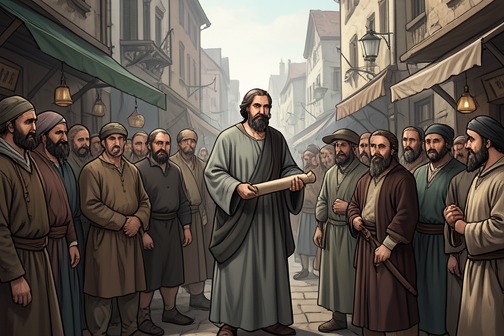
[Abu Simbel](entity:character-recall-character-abu-simbel-baf411fea682) summons [Baal](entity:character-recall-character-baal-37c79f1a3495) and commissions verses attacking [Mahound](entity:character-recall-character-mahound-81c492df6e1d) and his followers. He then proposes a political compromise: [Allah](entity:character-recall-character-allah-2f255d6fff8b) would recognize [Lat](entity:character-recall-character-lat-96caead1b2e6), [Uzza](entity:character-recall-character-uzza-1f4f640ba720), and [Manat](entity:character-recall-character-manat-71e98b6ea595) as lesser divine beings, while Mahound would gain acceptance and a place on [Jahilia](entity:location-recall-location-jahilia-a33d2f285acd)’s council.
Mahound takes the offer seriously. His followers fear that accepting it would destroy their credibility, but he wonders whether a limited concession might bring the city’s people to the new faith. His uncertainty exposes the struggle between conviction, political pragmatism, and the desire to be heard.
Shortly after Abu Simbel’s offer
The Satanic Verses Are Recited
On [Mount Cone](entity:location-recall-location-mount-cone-ff3b33d88f02), [Mahound](entity:character-recall-character-mahound-81c492df6e1d) asks whether the three goddesses might be granted an intermediary status. In his vision, Gibreel supplies words that permit their intercession, and Mahound recites them publicly at a poetry gathering, where [Abu Simbel and Hind](entity:relation-recall-relation-abu-simbel-and-hind-b443e7f6165a) lead the crowd in prostration.
[Khalid](entity:character-recall-character-khalid-c118097dd155) flees in distress, while Mahound remains standing amid the unexpected triumph. The recitation briefly reconciles the new faith with [Jahilia](entity:location-recall-location-jahilia-a33d2f285acd)’s religious order, but leaves Mahound uncertain whether the words came from God or from a deceptive source.
The day after the public recitation
Mahound Recants the Verses
[Mahound](entity:character-recall-character-mahound-81c492df6e1d) returns to [Mount Cone](entity:location-recall-location-mount-cone-ff3b33d88f02) and concludes that the earlier verses came from [Shaitan](entity:character-recall-character-shaitan-a2a9fe30c0a4) rather than Gibreel. He goes back to the [House of the Black Stone](entity:location-recall-location-house-of-the-black-s-ea63bf358886) and publicly replaces them, denying divine authority to the three goddesses.
The recantation ends the fragile reconciliation. Mahound’s followers face renewed danger, and the novel preserves the unsettling fact that the same visionary voice appears to have spoken both the concession and its repudiation.
The night after the recantation
Hamza Kills Hind’s Brothers
During [Jahilia](entity:location-recall-location-jahilia-a33d2f285acd)’s festival, [Hamza](entity:character-recall-character-hamza-75b9b93922dd) encounters masked attackers assaulting [Khalid](entity:character-recall-character-khalid-c118097dd155), Salman, and [Bilal](entity:character-recall-character-bilal-836cb0b5f1d4). He fights them off and kills two of [Hind](entity:character-recall-character-hind-6ddfa6500040)’s brothers, recognizing the danger of the revenge that will follow.
Hind’s grief becomes a lasting source of hostility toward [Mahound](entity:character-recall-character-mahound-81c492df6e1d) and his followers. The conflict shifts from theological rivalry into blood feud, while the masked festival turns Jahilia’s public celebrations into a landscape of menace.
After the recantation and the deaths of Hind’s brothers
The Faithful Are Driven from Jahilia
[Abu Simbel](entity:character-recall-character-abu-simbel-baf411fea682) directs a policy of persecution against the adherents of [Submission](entity:organization-recall-organization-submission-0fc238875a45). They face restrictions on work and movement, assaults, and attacks on their homes; [Mahound](entity:character-recall-character-mahound-81c492df6e1d)’s first wife dies during this period.
The pressure strengthens the community even as it makes survival harder. When [Yathrib](entity:location-recall-location-yathrib-3e5e9558c37d) offers refuge, [Hamza](entity:character-recall-character-hamza-75b9b93922dd) urges Mahound to leave, and the Prophet consents to lead his followers away from [Jahilia](entity:location-recall-location-jahilia-a33d2f285acd).
During the community’s years in Yathrib
Salman Loses Faith in Mahound
As [Mahound](entity:character-recall-character-mahound-81c492df6e1d)’s revelations increasingly prescribe rules for daily life, Salman, serving as his scribe, begins to suspect that the rules conveniently support the Prophet’s decisions. Salman quietly alters some of the words he records and discovers that Mahound does not always notice the changes.
The experience destroys Salman’s confidence in the divine origin of the recitation. He eventually leaves [Yathrib](entity:location-recall-location-yathrib-3e5e9558c37d) rather than risk exposure, carrying a dangerous secret about the authorship and authority of the sacred words.
About a quarter-century after the flight to Yathrib
Mahound Conquers Jahilia
[Mahound](entity:character-recall-character-mahound-81c492df6e1d) returns at the head of a victorious force. [Abu Simbel](entity:character-recall-character-abu-simbel-baf411fea682) surrenders [Jahilia](entity:location-recall-location-jahilia-a33d2f285acd) and offers protection to people who remain indoors or take refuge in his home; [Hind](entity:character-recall-character-hind-6ddfa6500040) urges the citizens to resist, but they abandon her appeal.
Mahound enters the city, destroys its idols, and accepts the submission of its people without ordering a general massacre. Hind also submits and is spared, while Salman is captured but survives after [Bilal](entity:character-recall-character-bilal-836cb0b5f1d4) intercedes for him. Mahound’s restraint answers the question of how a victor treats defeated enemies, though [Baal](entity:character-recall-character-baal-37c79f1a3495) remains beyond his reach.
After Mahound’s return to Jahilia
Baal Hides at the Curtain
With [Mahound](entity:character-recall-character-mahound-81c492df6e1d) seeking him, the aging [Baal](entity:character-recall-character-baal-37c79f1a3495) hides in the brothel called the Curtain. Its Madam and eunuchs conceal him in the maze of rooms and corridors, and he disguises himself as a eunuch.
From his hiding place, Baal hears that the city’s new rules have not erased its old appetites. The secret business at the Curtain reveals the gap between public submission and private conduct, and gives Baal a way to turn his survival into resistance.
During Baal’s years at the Curtain
The Wives of the Prophet Are Imitated
The Curtain’s prostitutes begin posing as [Mahound](entity:character-recall-character-mahound-81c492df6e1d)’s wives for their clients. Their assumed identities become so absorbing that they gradually lose touch with their former names and personalities.
[Baal](entity:character-recall-character-baal-37c79f1a3495) becomes their husband in the role-play, taking on a private parody of Mahound’s household and authority. The arrangement turns the brothel into a profane mirror of the religious order governing the city.
Several years after Mahound’s return
Baal and the Wives Are Executed
When the authorities close the Curtain, the prostitutes are arrested. [Baal](entity:character-recall-character-baal-37c79f1a3495) does not defend them when they are seized, but afterward he writes and recites poems outside the jail, revealing that the women had been impersonating [Mahound](entity:character-recall-character-mahound-81c492df6e1d)’s wives.
Baal is tried alongside the women. His account makes the audience laugh, but Mahound condemns the mockery and sentences him to death; the women are also sentenced. Baal’s final defiance identifies writers and prostitutes as people the Prophet cannot forgive.
At the end of Mahound’s life
Mahound Dies and Hind Takes Revenge
[Hind](entity:character-recall-character-hind-6ddfa6500040) spends years studying occult texts after the destruction of the temples of [Al-Lat](entity:character-recall-character-al-lat-d6d0d2a5c50c). When [Mahound](entity:character-recall-character-mahound-81c492df6e1d) becomes fatally ill, she celebrates his impending death and claims that her revenge has succeeded.
Mahound dies beside [Ayesha](entity:character-recall-character-ayesha-057b6e117188), telling her that he has chosen the kingdom of God. In his final vision, he recognizes Hind’s goddess as the source of his illness and thanks her for the gift of death. His followers mourn him while Ayesha insists that God, unlike the Messenger, remains alive.
Around 1947
Gibreel Is Born in Poona
[Gibreel Farishta](entity:character-recall-character-gibreel-farishta-2f6568f8882b) is born [Ismail](entity:character-recall-character-ismail-7acf3a2774f9) Najmuddin in Poona. His mother, [Naima Najmuddin](entity:character-recall-character-naima-najmuddin-513bfef4801e), calls him her personal angel, giving him the name that will later shape his imagination and public identity.
After the family moves to Bombay, he follows his father, [Najmuddin Senior](entity:character-recall-character-najmuddin-senior-004f04302e5c), into the work of delivering lunch tins. His childhood familiarity with supernatural stories makes angels, demons, and ghosts seem like ordinary features of the world.
Gibreel’s childhood and adolescence
Gibreel Loses His Parents
[Naima Najmuddin](entity:character-recall-character-naima-najmuddin-513bfef4801e) dies after being struck by a bus. Gibreel and [Najmuddin Senior](entity:character-recall-character-najmuddin-senior-004f04302e5c) bury their grief in harder work, each trying to prove his love and worth through the punishing routines of the lunch service.
Najmuddin Senior eventually dies after exhausting himself. [Babasaheb Mhatre](entity:character-recall-character-babasaheb-mhatre-d3da98c0c5d2) takes the orphaned Gibreel into his home, offering care and introducing him to ideas of rebirth and the supernatural.
From his early twenties through his thirties
Gibreel Becomes a Film Star
[Babasaheb Mhatre](entity:character-recall-character-babasaheb-mhatre-d3da98c0c5d2) arranges an audition that sends Gibreel from carrying lunch tins into the Bombay film industry. After several years in minor roles, he becomes famous playing the elephant-headed deity and later the monkey king.
His extraordinary popularity grows as he performs gods from several traditions. The boundary between the actor and his sacred roles begins to blur for his audience, while Gibreel himself comes to see rebirth and transformation as possible features of life.
During his years as a film star
Gibreel Begins an Affair with Rekha
Fame brings Gibreel many lovers, but his pattern of seduction and abandonment becomes especially complicated with [Rekha Merchant](entity:character-recall-character-rekha-merchant-331595d1431e). She is married, yet repeatedly forgives his carelessness and returns to him.
When Gibreel nearly dies from a mysterious internal hemorrhage, Rekha stays away to avoid scandal. Her absence and his later abandonment of her become sources of guilt and resentment that return to haunt him after the plane disaster.
Shortly before his fortieth birthday
Gibreel Recovers and Rejects Faith
After days of unexplained bleeding, Gibreel recovers from the illness that had seemed certain to kill him. During his hospital ordeal, he repeatedly prays to [Allah](entity:character-recall-character-allah-2f255d6fff8b) for help, then becomes convinced that no one is listening.
To demonstrate his loss of faith, he publicly eats pork at a hotel buffet. There he meets [Alleluia Cone](entity:character-recall-character-alleluia-cone-cb6830830952), whose challenge and presence make him imagine a life beyond his old routines and career.
Soon after Gibreel leaves Bombay
Rekha and Her Children Leap
Rekha reads Gibreel’s farewell message as a call to renewed life. She takes her three children to the roof of [Everest Vilas](entity:location-recall-location-everest-vilas-3b2ac7175252) and leaps with them to their deaths.
Gibreel later encounters Rekha as a ghost on a flying carpet. Her accusation that he escaped responsibility while women forgave him transforms their affair into a continuing presence in his dreams and waking life.
Saladin’s childhood in Bombay
Saladin Finds the London Wallet
As a boy, Saladin Chamchawala finds a wallet filled with British pounds near his home. His father, [Changez Chamchawala](entity:character-recall-character-changez-chamchawala-9dae4854fad5), takes it from him and later keeps a magic lamp just out of his reach.
The incident fixes in the boy’s mind the idea that escape and fulfillment lie in [England](entity:location-recall-location-england-b153c1f368ea), while his father stands between him and the future he wants. The dream of [London](entity:location-recall-location-london-420923d4a60a) becomes part of his self-invention.
During Saladin’s early adolescence
Saladin Is Assaulted at Scandal Point
While exploring the rocks at [Scandal Point](entity:location-recall-location-scandal-point-abe5e6642e39), Saladin is lured by an older man and sexually assaulted. He tells no one, fearing his parents’ reactions and suspecting that his father would blame him.
The assault deepens his revulsion toward Bombay and strengthens his determination to leave. The memory also becomes part of the painful history from which his chosen English identity attempts to separate him.
1961, when Saladin is thirteen
Saladin Moves to England
Changez takes his son to [England](entity:location-recall-location-england-b153c1f368ea) for school. In [London](entity:location-recall-location-london-420923d4a60a), he gives Saladin the confiscated wallet and immediately makes the boy responsible for the trip’s expenses.
At boarding school, Saladin learns to endure unfamiliar food, exclusion, and cold. He responds by cultivating English speech and manners, treating each new mask as a step toward becoming the person England might accept.
Several years after Saladin leaves for England
Nasreen Dies During an Air Raid
During a wartime air-raid warning, [Nasreen Chamchawala](entity:character-recall-character-nasreen-chamchawala-2192b9d65f50) remains beside a dining table and chokes on a fishbone while the guests hide. Saladin, usually so proud of his control, is too frightened to help her.
Her sudden death leaves him with grief and guilt he cannot express. Changez later remarries a woman also called Nasreen, and father and son exchange angry letters that deepen their estrangement.
From his late teens into adulthood
Saladin Builds an English Persona
After university, Saladin remains in [England](entity:location-recall-location-england-b153c1f368ea) and pursues acting, then finds success as a voice performer. He becomes known for accents and character voices while his own face remains largely unseen.
He marries [Pamela Lovelace](entity:character-recall-character-pamela-lovelace-92cf95db391e) and builds a comfortable life, but his identity depends on performance and recognition. The distance between his public Englishness and his unspoken past remains unresolved.
Late in the 1960s, followed by years of marriage
Saladin Marries Pamela
Saladin pursues [Pamela Lovelace](entity:character-recall-character-pamela-lovelace-92cf95db391e) for two years before she agrees to marry him. He relies on her belief in him, while failing to understand her fear and the emptiness hidden behind her bright public smile.
Their marriage becomes a meeting of crossed desires: Saladin loves the image of [England](entity:location-recall-location-england-b153c1f368ea) that Pamela’s voice represents, while Pamela increasingly feels unseen and interrupted. Their inability to have children adds strain to a relationship neither knows how to repair.
About fifteen years after he leaves for England
Saladin Returns to Bombay
Saladin returns to Bombay with the [Prospero Players](entity:organization-recall-organization-prospero-players-cd2166c7b8a1), performing in a touring production. His English accent begins to slip, and [Zeenat Vakil](entity:character-recall-character-zeenat-vakil-9d7276ba351a) confronts him with the distance between the city he remembers and the city’s lived realities.
Their brief affair unsettles his confidence in his adopted identity. Zeeny urges him to come home, but Saladin remains committed to returning to Pamela and the life he has constructed in [London](entity:location-recall-location-london-420923d4a60a).
During the same visit to Bombay
Saladin Confronts Changez
Saladin visits Changez at [Scandal Point](entity:location-recall-location-scandal-point-abe5e6642e39) and discovers that the old house has been preserved as a memorial to his dead mother. He is shocked to find his father living openly with [Kasturba](entity:character-recall-character-kasturba-52dcda38457f), while Kasturba’s husband accepts the arrangement as an act of devotion.
The encounter turns Saladin’s accusations back on him: he has returned to condemn his father without understanding the lives left behind. Changez later sends him money from the felled walnut tree, and Saladin leaves Bombay still unable to settle what he owes his father.
On Flight AI-420, before the fall to England
The Hijacking Begins
On Air [India](entity:location-recall-location-india-39df7eae59c1) Flight AI-420, four hijackers seize the aircraft. Saladin recognizes the vanished film star [Gibreel Farishta](entity:character-recall-character-gibreel-farishta-2f6568f8882b) among the passengers, while a woman carrying a baby and the creationist speaker [Eugene Dumsday](entity:character-recall-character-eugene-dumsday-aef02b3e7fec) are also aboard.
The hostages are held at a desert airstrip for 111 days. The long captivity blurs ordinary time, intensifies fear, and gives Gibreel the sleeplessness in which his recurring visions begin to dominate him.
The 110th day of the hostage crisis
Jalandhri Is Executed
As the hijackers’ ultimatum expires, [Tavleen](entity:character-recall-character-tavleen-cafae61f3ee9) selects Jalandhri, a Sikh hostage who has cut his hair, as the first person to die. She shoots him at the aircraft door while the other captives watch.
The execution marks the collapse of any remaining hope that the crisis will end through negotiation. With fuel running low, the plane’s fate becomes inseparable from the captives’ fear and Gibreel’s visions.
After 111 days of captivity, over the English Channel
The Bostan Breaks Apart
As the [Bostan](entity:object-recall-object-bostan-3dc64c50b3d2) approaches [England](entity:location-recall-location-england-b153c1f368ea), the hijackers fight among themselves and the aircraft breaks apart in midair. [Gibreel Farishta](entity:character-recall-character-gibreel-farishta-2f6568f8882b) and [Saladin Chamcha](entity:character-recall-character-saladin-chamcha-3a32acdec048) fall from the wreckage toward the [English Channel](entity:location-recall-location-7f5e81ca4a72).
Their survival begins a new phase in which bodily transformation and uncertain agency become impossible to separate. The narrator claims that Saladin willed their survival and Gibreel did what was willed, leaving the question of who performed the miracle unresolved.
Immediately after the Bostan disaster
The Two Men Reach the Coast
As they fall through clouds that seem to transform them, Gibreel sings and flaps his arms while Saladin urges him to fly. They descend into the sea and are found alive on a winter beach, the only survivors of the crash.
Gibreel believes they walked on water; Saladin attributes their survival to luck. Both men have changed: Gibreel’s breath is sweet, Saladin’s foul, and the first signs of Saladin’s horns are beginning to appear.
The morning after the crash
Rosa Diamond Takes Them In
[Rosa Diamond](entity:character-recall-character-rosa-diamond-87836d5badd6) finds the survivors on her beach and brings them into her house. Gibreel is drawn into her stories of an earlier life in [Argentina](entity:location-recall-location-27e2c37f5c3d), while Saladin lies ill with his body encased in ice and fears that he is dying.
Rosa mistakes Gibreel for the lost love of her youth, [Martin de la Cruz](entity:character-recall-character-martin-de-la-cruz-bc789387c2bf). Her memories begin to shape the world around him, making her house another place where the boundary between dream and waking life gives way.
During the survivors’ first days in Rosa’s house
Rosa Recounts Her Argentine Past
Rosa tells Gibreel about her marriage to [Henry Diamond](entity:character-recall-character-henry-diamond-3ea0872ae1ed) and her life at [Los Alamos Estate](entity:location-recall-location-los-alamos-c5d1abc0dd4f), where she fell in love with [Martin de la Cruz](entity:character-recall-character-martin-de-la-cruz-bc789387c2bf). Her memories shift between versions of their relationship and of Martin’s violent death.
As Rosa weakens, her past becomes vivid around Gibreel, who is drawn into the unfinished story. He experiences her memories as a force acting upon him, much as [Mahound](entity:character-recall-character-mahound-81c492df6e1d)’s need had once compelled Gibreel in his dreams.
Several days after the crash
Rosa Diamond Dies
Rosa’s memories intensify as she approaches death, bringing back the violent and uncertain story of Martin’s killing. Gibreel sees the past shift between possible versions, while Rosa remains unable to look directly at her history.
After she finally dies, Gibreel leaves her house for [London](entity:location-recall-location-london-420923d4a60a). Her death ends the immediate force of her stories, but her ghost continues to haunt him and to challenge his understanding of love, guilt, and punishment.
Soon after Rosa’s death
Gibreel Reunites with Allie
Gibreel reaches [London](entity:location-recall-location-london-420923d4a60a) and collapses in the snow near [Alleluia Cone](entity:character-recall-character-alleluia-cone-cb6830830952)’s flat. Allie recognizes him, takes him home, and believes his account of surviving the plane crash.
After sleeping for days, Gibreel resumes his passionate relationship with her. They share a sense that each has been shaped by extraordinary experiences, but both conceal visions and fears that threaten their intimacy.
During Gibreel’s recurring dreams in London
The Imam Dreams of Revolution
In one of Gibreel’s serial dreams, an exiled Imam in [Kensington](entity:location-recall-location-952985f44709) asks Gibreel to carry him to [Jerusalem](entity:location-recall-location-695056030a63). They fly to [Desh](entity:location-recall-location-desh-148744090166), where the people march toward the Empress’s palace and are shot down in enormous numbers.
The Imam declares that the revolution will overthrow not only a ruler but history itself. Gibreel sees the people’s victory become another kind of tyranny when [the Imam](entity:character-recall-character-35ae6937a6f9) swallows them, and the clocks begin to mark an imagined timeless order.
Within Gibreel’s later serial dreams
Ayesha Appears in Titlipur
In another dream, the landowner [Mirza Saeed Akhtar](entity:character-recall-character-mirza-saeed-akhtar-2fd5e1437351) discovers [Ayesha](entity:character-recall-character-ayesha-057b6e117188) eating butterflies in the garden of [Peristan Mansion](entity:location-recall-location-a7d6c2830ff8). After she collapses, she claims that Gibreel has appeared to her and given her a message.
The villagers’ long-standing hopes gather around Ayesha, whom they begin to regard as the successor to a local saint. Her authority grows through signs, stories, and the butterflies that accompany her.
After her walk from Titlipur to Chatnapatna
Ayesha Transforms and Claims Revelation
[Ayesha](entity:character-recall-character-ayesha-057b6e117188) returns to [Titlipur](entity:location-recall-location-titlipur-051b5f3ee52a) transformed: her hair has turned white, her skin appears renewed, and butterflies cover her naked body. She tells the village headman that Gibreel has visited her and that the village must prepare for a pilgrimage.
Her visions are never fully explained, and Gibreel’s dream-self insists that he did not knowingly lie with her. The episode repeats the novel’s central uncertainty about who speaks through a messenger and how belief turns private experience into public command.
Before the villagers leave Titlipur
The Villagers Choose the Pilgrimage
[Ayesha](entity:character-recall-character-ayesha-057b6e117188) tells the village council that every man, woman, and child must walk to [Mecca](entity:location-recall-location-mecca-0a2fc0c82336). She promises that the [Arabian Sea](entity:location-recall-location-arabian-sea-c6dbb6bf7a27) will part at the angel’s command, allowing the pilgrims to cross on foot.
Mirza Saeed rejects the claim but decides to follow in an effort to stop what he sees as a lethal delusion. [Mishal Akhtar](entity:character-recall-character-mishal-akhtar-cc3e3f836f44), who has cancer, believes the pilgrimage may cure her and refuses his offer to take her to Mecca by car.
The morning after the council’s decision
The Pilgrims Leave Titlipur
The villagers pool their food and belongings and set off on foot, carrying infants and taking only limited supplies. Mirza Saeed argues with them and then joins the expedition in his Mercedes-Benz, hoping to persuade his wife and the villagers to turn back.
The pilgrimage begins as a communal decision but soon becomes a test of endurance and obedience. Saeed’s car sets him apart from the people he is trying to save, even as he remains emotionally bound to them.
The third week of the pilgrimage
Khadija Dies on the Road
[Khadija](entity:character-recall-character-khadija-6cbf127cf5a1), [the Sarpanch’s wife](entity:character-recall-character-53766db431ce), dreams that [Azraeel](entity:character-recall-character-azraeel-02e9c1ffd92a) has come for her. The next day she stops at the ruin of an old way station and dies there, leaving [Muhammad Din](entity:character-recall-character-muhammad-din-c5b775df3772) devastated.
[Ayesha](entity:character-recall-character-ayesha-057b6e117188) tells him that Khadija has reached Paradise, but his grief cannot be eased by the assurance. When he asks to ride in Saeed’s car, the first major break forms in the pilgrims’ unity.
The fourth week of the pilgrimage
The Sarpanch Leaves the Pilgrimage
[Muhammad Din](entity:character-recall-character-muhammad-din-c5b775df3772) accepts a place in Mirza Saeed’s Mercedes after [Khadija](entity:character-recall-character-khadija-6cbf127cf5a1)’s death. His changed position weakens the pilgrims’ unity and lends Saeed’s practical objections new authority.
[Ayesha](entity:character-recall-character-ayesha-057b6e117188) disappears for a day and a half, then returns with gold in her hair and warns that Gibreel may withdraw the promised miracle. Her renewed certainty draws the villagers back toward her, even as doubt continues to spread.
Around the sixth week of the pilgrimage
Osman Loses Boom
[Osman](entity:character-recall-character-osman-f9db8cdef0b8)’s bullock, [Boom](entity:character-recall-character-boom-c67b1279e4a5), collapses and dies in a crowded town. [Ayesha](entity:character-recall-character-ayesha-057b6e117188) says that bullocks have no souls, and Osman, grieving, tells her that she has become a demon.
The loss exposes the cost of the pilgrimage and hardens Ayesha’s discipline. More elderly pilgrims and a child die along the route, while Saeed takes responsibility for burying the dead whom the marchers leave behind.
During the later weeks of the pilgrimage
Saeed Challenges the Faithful
As deaths accumulate, Mirza Saeed tells stories meant to persuade the villagers that they are following a destructive delusion. He recites poetry and describes the dangers of blind obedience, while [Ayesha](entity:character-recall-character-ayesha-057b6e117188) warns that the Devil speaks through doubt.
The dispute grows more intimate when [Mishal](entity:character-recall-character-mishal-9ec76178a43a) accuses Saeed of coldness and refuses his offer of medical treatment. Her loyalty to Ayesha leaves Saeed isolated, even though his concern for his wife is the reason he joined the march.
The ninth week of the pilgrimage
The Pilgrims Enter Sarang
As the pilgrims approach [Sarang](entity:location-recall-location-sarang-3e457e2471ba), communalist groups denounce the march and a hostile crowd gathers. The miners of Sarang, stirred by agitators, prepare to block the pilgrims with bicycles and weapons.
[Ayesha](entity:character-recall-character-ayesha-057b6e117188) insists that there will be no trouble. Mirza Saeed fears a massacre, while [Srinivas](entity:character-recall-character-srinivas-41914cc78c9f), unwilling to take either side in the coming confrontation, joins Saeed’s small group of dissenters.
The morning the pilgrims reach the hostile barricade
The Sarang Flood
As [Ayesha](entity:character-recall-character-ayesha-057b6e117188) approaches the mob, a vast rainstorm breaks over [Sarang](entity:location-recall-location-sarang-3e457e2471ba). Water sweeps away the bicycle barricade and scatters both pilgrims and attackers through flooded streets.
Mirza Saeed drives through the inundated suburb and rescues Ayesha, [Mishal](entity:character-recall-character-mishal-9ec76178a43a), and others in his group. The storm seems to vindicate Ayesha’s prediction, but its force also causes a deadly disaster beneath Sarang’s hills.
Immediately after the flood
The Sarang Mine Collapses
The rainstorm is followed by a collapse at the [Sarang](entity:location-recall-location-sarang-3e457e2471ba) coalfield, burying fifteen thousand miners underground. [Ayesha](entity:character-recall-character-ayesha-057b6e117188) calls the deaths a judgment on those who opposed the pilgrimage.
Saeed protests that the miners were not part of the mob and were working beneath the ground. The calamity leaves him even more troubled by Ayesha’s ability to interpret suffering as proof of divine purpose.
After the Sarang flood and mine collapse
The Butterflies Return
The butterflies reappear in a vast golden cloud and guide scattered villagers back to the pilgrimage. Some survivors claim that the insects healed wounds or revived people who had drowned.
Saeed insists that the storm explains the survivors’ return, but the sight of the butterflies makes his rational account increasingly difficult to sustain. The miracle renews the pilgrims’ faith and deepens his isolation.
During the pilgrims’ final days in the city
The Foundling Is Stoned
Outside a mosque, a newborn baby is found in a basket. The young Imam calls the child the Devil’s offspring, and [Ayesha](entity:character-recall-character-ayesha-057b6e117188) tells the crowd that everything will be required of them.
The crowd stones the baby to death. The pilgrims are appalled and refuse to continue, exposing a brutal cost of the same absolutist faith that has carried them across the country.
At the end of the pilgrimage
The Pilgrims Enter the Sea
At the shore, [Ayesha](entity:character-recall-character-ayesha-057b6e117188) tells the villagers that the sea is like the human soul and will open to those who open their hearts. The butterflies form a gigantic angelic shape over the water and dive into it, while only Mirza Saeed can see the spectacle.
The villagers walk into the sea and disappear beneath the surface. The surviving witnesses disagree about whether the water parted, but each insists that the others reached a miraculous destination; Saeed alone returns without seeing the promised passage.
After the pilgrims disappear
Saeed Returns to Peristan
After weeks of grief, Mirza Saeed returns to [Peristan Mansion](entity:location-recall-location-a7d6c2830ff8). He finds the house and grounds decaying, the village nearly abandoned, and the landscape transformed by drought.
He withdraws from the world, refusing food and contact. When fire consumes the great tree, Saeed sees [Ayesha](entity:character-recall-character-ayesha-057b6e117188) again in a final vision and opens himself to her, joining the vanished pilgrims in his imagination—or in the novel’s unresolved miracle.
The day after Rosa takes the survivors in
Saladin Is Arrested
Police arrive at [Rosa Diamond](entity:character-recall-character-rosa-diamond-87836d5badd6)’s house after a report of suspicious people on the beach. Immigration officers identify Saladin as a foreigner and arrest him, ignoring his claims that he is a British citizen and an actor.
When his horns become visible, the officers treat his transformation as evidence of criminality rather than as an impossible event. Gibreel’s halo appears before the police, but Gibreel fails to help Saladin, a betrayal that later becomes the foundation of Saladin’s revenge.
During his police detention
Saladin Becomes Goatlike
In a police van, Saladin discovers that his body has grown goatlike legs, hooves, horns, and a tail. Officers mock and assault him, treating his terror as entertainment and his transformed body as a reason to deny his humanity.
At the hospital and detention centre, he meets other transformed people who believe that authorities can alter them simply by describing them. Saladin resists that explanation, but his changing body and the state’s violence make it increasingly difficult to preserve his old sense of self.
Several days after Saladin’s arrest
The Detainees Escape
With help from [Hyacinth Phillips](entity:character-recall-character-hyacinth-phillips-788e87ecfde8) and other inmates, transformed detainees and migrants break out of the sanatorium and detention centre. They escape through holes in the perimeter fence and scatter into the night.
Saladin returns to [London](entity:location-recall-location-london-420923d4a60a) with [Jumpy Joshi](entity:character-recall-character-jumpy-joshi-9578cf1e2b77), who brings him to the [Shaandaar Café](entity:location-recall-location-shaandaar-caf-bd98fdb7e649). His escape delivers him into a community that recognizes him as one of its own, even as Saladin insists that he has spent his life trying to get away from it.
After his escape from detention
Saladin Takes Shelter at the Shaandaar
[Muhammad Sufyan](entity:character-recall-character-muhammad-sufyan-ae5aa1300f2a) welcomes Saladin into the Shaandaar, where [Hind](entity:character-recall-character-hind-6ddfa6500040) is horrified by the goatlike stranger. Sufyan and his daughters, [Mishal](entity:character-recall-character-mishal-9ec76178a43a) and [Anahita](entity:character-recall-character-c5b20febac79), respond with curiosity and kindness, while Jumpy urges them to see Saladin as a victim of wrongful detention and violence.
Saladin rejects the idea that he belongs among them. His resistance reveals how thoroughly he has defined himself against his origins, even as his altered body forces him into a community he had tried to leave behind.
During his first weeks at the Shaandaar
Saladin Loses His Voice Work
Saladin learns that his agent, [Mimi Mamoulian](entity:character-recall-character-mimi-mamoulian-ff4c1cfc6ff1), has lost work and that the Aliens show has dismissed him. [Hal Valance](entity:character-recall-character-hal-valance-c91b4403f818) claims that Saladin’s presence makes the programme too racial for its audience and replaces him with a white performer in prosthetic makeup.
The dismissal confirms Saladin’s growing sense that his polished English identity cannot protect him from racial exclusion. The same industry that profited from his ability to imitate others now rejects his actual body.
During his confinement above the Shaandaar
Saladin’s Horns Begin to Recede
After hearing that Gibreel has publicly claimed he missed the [Bostan](entity:object-recall-object-bostan-3dc64c50b3d2), Saladin flies into a rage and calls him a liar. During the outburst, Saladin’s horns shrink slightly, though no one notices.
The brief physical change suggests that anger, self-recognition, or some other inner force may affect his metamorphosis. Saladin himself remains focused on Gibreel’s apparent betrayal and does not recognize the possible significance.
Over the months following his arrival at the Shaandaar
Saladin Becomes a Symbol in Brickhall
As Saladin’s demonic image appears in people’s dreams, local businesses and political groups turn it into badges, posters, and an emblem of defiance. Young residents begin to identify with the rejected figure, seeing in him a black and brown man who has been made monstrous by society.
Saladin resents the public use of his image, but his anger and growing physical transformation make him resemble the figure others have invented. His body becomes part of a wider struggle over race, power, and representation.
During Saladin’s months at the Shaandaar
Uhuru Simba Is Arrested
Police arrest [Uhuru Simba](entity:character-recall-character-uhuru-simba-0d2855631712) in connection with the Granny Ripper murders and threaten to frame him for occult crimes. [Hanif Johnson](entity:character-recall-character-hanif-johnson-f38007cdb2b6) warns the Shaandaar community that the arrest may provoke retaliation and further racialized policing.
The evidence against Simba is weak, but public suspicion and political hostility make the case dangerous. Saladin initially questions Simba’s record of violence, while Jumpy argues that a flawed man can still be innocent of murder.
Several days after his arrest
Simba Dies in Custody
[Uhuru Simba](entity:character-recall-character-uhuru-simba-0d2855631712) dies in his cell after officers claim that he fell from a bunk during a nightmare. The police call his death an extraordinary accident, but his family and supporters suspect that he was killed in custody.
His death intensifies anger in [Brickhall](entity:location-recall-location-brickhall-634536010d9f). New murders attributed to the Granny Ripper, combined with police raids and racist violence, bring the neighbourhood closer to open confrontation.
After Gibreel returns to London and before the Brickhall riots
Saladin Reclaims His Human Form
At [Club Hot Wax](entity:location-recall-location-club-hot-wax-d61e726fa5c2), Saladin recognizes Gibreel as the figure he blames for his suffering. His hatred becomes so concentrated that he destroys the club’s waxworks and wakes in human form.
The transformation does not erase the damage done to him, but it restores his familiar body and gives him a new sense of power. [Mishal](entity:character-recall-character-mishal-9ec76178a43a) and her friends help him hide as he begins to consider action against Gibreel.
After his reunion with Alleluia in London
Gibreel Encounters God
During a jealous quarrel with Alleluia, Gibreel sees an apparition he identifies as God. The apparition tells him that his dreams have revealed his angelic identity and commands him to carry out divine work.
Gibreel leaves Alleluia and begins to perceive [London](entity:location-recall-location-london-420923d4a60a) as a corrupted city in need of redemption. His certainty that he is the archangel grows alongside signs of a serious mental crisis.
During the months after his break with Alleluia
Gibreel Tries to Redeem London
Gibreel walks through a [London](entity:location-recall-location-london-420923d4a60a) whose streets and buildings appear to embody spiritual decay. He tries to impose order on the city and believes that his angelic sight reveals the hidden evil beneath ordinary surfaces.
His visions become increasingly difficult to distinguish from waking experience. He interprets strangers, public spaces, and social conflict as parts of a divine struggle, while the people around him see an increasingly disturbed man.
During Gibreel’s wandering through London
Gibreel Rejects Rekha’s Bargain
[Rekha Merchant](entity:character-recall-character-rekha-merchant-331595d1431e) appears to Gibreel and offers to end the city’s transformations if he will admit that he loves her and continue their affair in death. She reminds him that he once accepted her forgiveness without accepting responsibility.
Gibreel refuses, declaring that there can be no compromise with a phantom. The vision disappears, and he interprets his decision as proof that he has passed a spiritual test, even as his isolation and delusion deepen.
After rejecting Rekha’s bargain
Gibreel Fails to Reveal Himself
Convinced that he is an archangel, Gibreel makes himself gigantic above the Thames and calls on Londoners to repent. They do not see or hear him, and he grows furious at their indifference.
His failure to compel attention exposes the limits of his imagined power. A car strikes him as he steps into the road, and [S. S. Sisodia](entity:character-recall-character-s-s-sisodia-b741f848ea86) takes him back to Alleluia’s care.
During his recovery under medical care
Gibreel Returns to Filmmaking
With Alleluia’s support and treatment at [Maudsley Hospital](entity:location-recall-location-maudsley-hospital-6ceb33359927), Gibreel begins to stabilize. [S. S. Sisodia](entity:character-recall-character-s-s-sisodia-b741f848ea86) arranges a film project based on the stories Gibreel has told during his illness, hoping that cinema will help him distinguish fiction from delusion.
Gibreel agrees to return to work, but the project also draws him back into celebrity, publicity, and the pressures that had shaped his earlier life. Alleluia worries that the film people are taking over his recovery.
After Gibreel resumes public work
Alleluia Leaves Gibreel
As Gibreel becomes absorbed in his career and jealous of Alleluia, he subjects her to suspicion and surveillance. She discovers that he has had her followed and leaves him a note saying that the relationship is killing her.
Gibreel does not call her. He immerses himself in rehearsals for a public comeback, interpreting her departure as betrayal and preparing to re-enter the world as a star.
During the film-star show at Earls Court
Gibreel Disappears at Earls Court
Gibreel appears as a surprise performer in an elaborate angel costume and descends toward a crowd wearing toy horns and haloes. The cheering audience surges toward the stage, and Gibreel believes he must choose between two realities.
He vanishes during the riot, while the official account claims he escaped in a suspended stage chariot. Rumours spread that he levitated, and toy haloes and devil horns become popular among [London](entity:location-recall-location-london-420923d4a60a)’s Asian communities.
After his disappearance at Earls Court
Gibreel Attempts to Tropicalize London
Gibreel imagines that [London](entity:location-recall-location-london-420923d4a60a)’s temperate weather has weakened its inhabitants’ moral distinctions. He resolves to transform the city into a tropical landscape of heat, vivid colour, and intensified feeling.
At the moment he attempts the transformation, Saladin’s face appears in his mind, and Gibreel returns instead to Alleluia’s doorstep. The failure reinforces the connection between the two men and the unresolved conflict between their inner realities.
After Saladin’s recovery at the Shaandaar
Saladin Goes Home to Pamela
Saladin returns to Pamela’s house and announces that he will move back in temporarily before they divorce. He discovers that he no longer loves her, but recognizes that neither their marriage nor their shared history can be erased by simple refusal.
[Jumpy Joshi](entity:character-recall-character-jumpy-joshi-9578cf1e2b77), who is now Pamela’s lover, is so unsettled by Saladin’s return that he waits outside until Saladin invites him back into the house. Saladin chooses restraint rather than asserting ownership over Pamela or punishing Jumpy.
During the aftermath of Simba’s arrest
Saladin Attends the Simba Meeting
At a public meeting supporting [Uhuru Simba](entity:character-recall-character-uhuru-simba-0d2855631712), Saladin hears the accused man’s mother describe his defiance in court and sees a broad community gathered around a contested cause. He notices [Mishal](entity:character-recall-character-mishal-9ec76178a43a) among the supporters and experiences a sudden premonition of death.
The vision unsettles his attempt to return to ordinary life. Rather than go home, he walks away, recognizing that he cannot simply restore the person he was before the fall.
The night Simba’s suspected killer is captured
The Brickhall Riots Begin
A Sikh patrol captures a man suspected of the Granny Ripper murders, but rumours of a police cover-up spread through [Brickhall](entity:location-recall-location-brickhall-634536010d9f). Police declare riot conditions after crowds gather and isolated acts of vandalism begin.
The ensuing confrontation turns neighbourhood anger into a public struggle involving police, racialized communities, and political groups. Saladin, leaving Alleluia after dinner, runs through the Fields toward the Shaandaar as officers and helicopters advance.
During the Brickhall riots
Gibreel Burns the Pimps
In a [London](entity:location-recall-location-london-420923d4a60a) transformed by Gibreel’s visions, he hears the unspoken desires of young women being exploited by pimps. He stands with them as their protectors arrive, then blows the horn named [Azraeel](entity:character-recall-character-azraeel-02e9c1ffd92a) and burns the men away.
Gibreel interprets the act as a divine response to suffering. The power to grant people’s desires soon becomes dangerous: he decides that the city itself should be consumed by the violence and wishes of its inhabitants.
Later that night during the Brickhall riots
The Shaandaar Burns
As the [Shaandaar Café](entity:location-recall-location-shaandaar-caf-bd98fdb7e649) burns, Gibreel sees Saladin inside and recognizes that Saladin’s apparent adversary is not an external demon but a darkness that has grown within his friend. Saladin, having taken revenge by manipulating Gibreel’s jealousy, runs back into the building to help those trapped inside.
Gibreel drops his trumpet, frees Saladin from a fallen beam, and carries him through fire and smoke. The rescue does not erase Saladin’s betrayal, but it offers a small act of forgiveness amid the night’s violence.
After the Shaandaar fire
Mishal and Hanif Rebuild Their Lives
[Mishal](entity:character-recall-character-mishal-9ec76178a43a) survives the fire but loses her parents and struggles with guilt. She and Hanif marry, and the Shaandaar is prepared to reopen under her management; [Anahita](entity:character-recall-character-c5b20febac79), too, begins to rebuild her life.
Saladin’s attempt to save Mishal’s family becomes part of his gradual movement away from hatred. Gibreel recovers from exhaustion, but his visions continue, and the two men have not yet fully reconciled.
In Gibreel’s final serial dream
The Pilgrims Continue Toward the Sea
The dream returns to the [Ayesha Pilgrims](entity:organization-recall-organization-ayesha-pilgrims-ce7c35ea437b) after the flood and the mine disaster. Despite the deaths along the route, the villagers reach the city and continue toward the [Arabian Sea](entity:location-recall-location-arabian-sea-c6dbb6bf7a27), while [Mishal](entity:character-recall-character-mishal-9ec76178a43a)’s cancer advances and Saeed’s marriage deteriorates.
The pilgrims become divided between those who still trust [Ayesha](entity:character-recall-character-ayesha-057b6e117188) and those who doubt her revelations. Their journey remains a struggle between faith, fear, exhaustion, and the possibility that a promised miracle may exact an intolerable price.
Near the end of the Ayesha pilgrimage
The Pilgrims Find the Abandoned Baby
Outside a mosque, a foundling is denounced as the Devil’s child and stoned by the crowd. The pilgrims refuse to continue immediately, disturbed by the violence and by [Ayesha](entity:character-recall-character-ayesha-057b6e117188)’s claim that they must accept whatever is demanded of them.
Saeed asks how the angel communicates with Ayesha. She answers that Gibreel sings to her in the tunes of popular songs, and Saeed laughs at what he sees as proof that her revelations are fabricated.
At the close of the Ayesha dream
The Sea Takes the Pilgrims
[Ayesha](entity:character-recall-character-ayesha-057b6e117188) leads the remaining villagers into the [Arabian Sea](entity:location-recall-location-arabian-sea-c6dbb6bf7a27), where they disappear beneath the surface. The witnesses on shore disagree about what they saw: some claim the sea divided, while Saeed insists that his wife and the others drowned.
Saeed returns to [Peristan](entity:location-recall-location-peristan-9e7db13f459b) in grief and withdraws from life. In his final vision, he sees the butterflies, the sea, and Ayesha; only when he opens himself to her does the dream’s sea part and carry him toward the vanished pilgrims.
Eighteen months after the Brickhall fire
Changez Chamchawala Falls Ill
A telegram summons Saladin to Bombay because Changez is dying of multiple myeloma. After delays in obtaining a visa, Saladin flies on the Air [India](entity:location-recall-location-india-39df7eae59c1) aircraft named Gulistan, accompanied by [S. S. Sisodia](entity:character-recall-character-s-s-sisodia-b741f848ea86).
The journey forces him to confront his fear of flight and his unresolved relationship with his father. This time, he feels an immediate need to reach Changez before death makes reconciliation impossible.
The first day of Saladin’s return to Scandal Point
Saladin Reconciles with His Father
Saladin reaches [Scandal Point](entity:location-recall-location-scandal-point-abe5e6642e39) and finds Changez gravely ill, cared for by [Nasreen II](entity:character-recall-character-nasreen-ii-3208f9d3770d) and [Kasturba](entity:character-recall-character-kasturba-52dcda38457f). The illness has stripped away much of the domineering father Saladin remembers, allowing him to experience affection and tenderness for him again.
Saladin helps shave and care for Changez, and Changez tells him that the old quarrels no longer matter. The reconciliation comes late, but it reconnects Saladin with his birth name and with parts of himself he had tried to discard.
The second day after Saladin’s return
Changez Accepts His Death
After his cancer is finally disclosed to him, Changez says that he knows he is dying and accepts the end without invoking God. He fears pain and the loss of dignity, but is reassured that he has so far been spared the worst of it.
Changez gives Saladin the magic lamp he once withheld. The gesture turns an old symbol of paternal promise into a final inheritance, while leaving Saladin to face the limits of what a wish can accomplish.
That night at Breach Candy Hospital
Changez Chamchawala Dies
Changez’s condition worsens, and Saladin takes him to [Breach Candy Hospital](entity:location-recall-location-breach-candy-hospita-cb7b28cf210b). Changez loses the ability to speak and dies after an unsuccessful medical effort to revive him.
Saladin watches the fear in his father’s final expression and then sees a faint smile. He helps wash and bury Changez, carrying his father’s head as the body is lowered into the grave.
After Changez’s funeral
Zeenat Returns to Saladin
Saladin goes to his father’s study and rubs the magic lamp, but no supernatural being appears. Instead, [Zeenat Vakil](entity:character-recall-character-zeenat-vakil-9d7276ba351a) enters, apologizing for not being present when Changez died and offering to stay with Saladin.
Saladin tells her that he loves her. Zeeny refuses to treat the declaration as settled truth, but her return gives Saladin a chance to begin again without pretending that his past has vanished.
After Changez’s death
Saladin Accepts the Solan School
Saladin learns that his father’s will leaves him the family fortune on condition that he accept the requisitioned school at Solan. He also protests [Kasturba](entity:character-recall-character-kasturba-52dcda38457f)’s decision to sell the old family house, but she insists that it is hers to decide.
Saladin recognizes that he cannot preserve every object and place from childhood. Zeeny urges him to let the house go and make an adult connection with Bombay as it exists now, rather than treating it as a museum of lost time.
Soon after the funeral
Saladin Joins the Human Chain
Zeeny, [George Miranda](entity:character-recall-character-george-miranda-b52f68cc60be), [Bhupen Gandhi](entity:character-recall-character-bhupen-gandhi-f155c5acfc32), and their allies organize a human chain through Bombay to oppose communal violence. Saladin joins them, surprised to find himself participating in a political demonstration he would once have avoided.
The chain succeeds in bringing thousands together, but the government media largely ignore it. On the same day, headlines instead report the deaths of [S. S. Sisodia](entity:character-recall-character-s-s-sisodia-b741f848ea86) and [Alleluia Cone](entity:character-recall-character-alleluia-cone-cb6830830952) and the disappearance of Gibreel.
On the day of the Mumbai human-chain demonstration
Sisodia and Alleluia Die
[S. S. Sisodia](entity:character-recall-character-s-s-sisodia-b741f848ea86) is found murdered in Gibreel’s apartment, and [Alleluia Cone](entity:character-recall-character-alleluia-cone-cb6830830952) is found dead after falling from the roof of [Everest Vilas](entity:location-recall-location-everest-vilas-3b2ac7175252). Gibreel disappears and becomes the subject of a police search.
The deaths connect Gibreel’s failing mental state to the unresolved visions of Rekha and the violence surrounding his relationship with Alleluia. Saladin believes that his own earlier manipulation helped set the tragedy in motion.
Several days after the deaths
Gibreel Tells His Final Story
Gibreel secretly visits Saladin at [Scandal Point](entity:location-recall-location-scandal-point-abe5e6642e39) and tells him that, during an episode of illness, he believed [Sisodia](entity:character-recall-character-sisodia-e6cada58ef19) and Alleluia were betraying him. He says he shot Sisodia and that Rekha appeared, then pushed Alleluia from the roof; he insists that he did not push her himself.
His account is confused and self-incriminating, leaving Saladin to confront the possibility that both deaths arose from Gibreel’s delusion and his own earlier acts of revenge. The story ends not with certainty about every detail, but with the consequences of violence and a final decision about how to live.
Immediately after telling his story
Gibreel Shoots Himself
Police arrive at the house, and Gibreel removes the lid of the magic lamp to reveal a revolver hidden inside. He tells Saladin that he cannot bear the return of his illness and shoots himself.
Saladin watches him die and then turns away from the sentimental view of the sea outside his childhood window. With Zeeny beside him, he chooses to leave the past behind and accept another chance at life, without believing that it will be free of pain or contradiction.